 Search
- # Forbidden City
- The Forbidden City: A Bright Legend of the World's Cultural Treasures
- Feb,12,2025
Located in the Dongcheng District of Beijing, the Forbidden City (the Imperial Palace) is one of the “Five Great Palaces of the World”, along with Versailles, Buckingham Palace, the White House and the Kremlin. It covers an area of 780,000 square meters and is surrounded by a 10-meter-high wall and a 52-meter moat. Its plane is rectangular, 753 meters wide east to west, 961 meters long north to south, east to west, north to south, each with a city gate, which the north of the Shenwu Gate and the south of the Noon Gate for tourists to visit in and out. The Forbidden City is not only a solemn and splendid building, but also the imperial palace of the Ming and Qing dynasties and a comprehensive museum with many precious historical relics.
---
In the Han Dynasty, the Forbidden City is known as “zigong”, because it is the royal land ordinary people are not allowed to enter, the Tang Dynasty and the “forbidden land”, and later the two together will have the “Forbidden City “ name. Ming Dynasty Emperor Zhu Di moved the capital of Beijing began to create the palace, built in Ming Yongle 4 years, 18 years completed. During the five hundred years of the Ming and Qing dynasties, 24 emperors lived here and ruled the country. The Forbidden City was listed as one of the first “key cultural relics protection units” in 1961, and was inscribed on the “World Cultural Heritage List” in 1987, making it a famous landmark in Beijing.
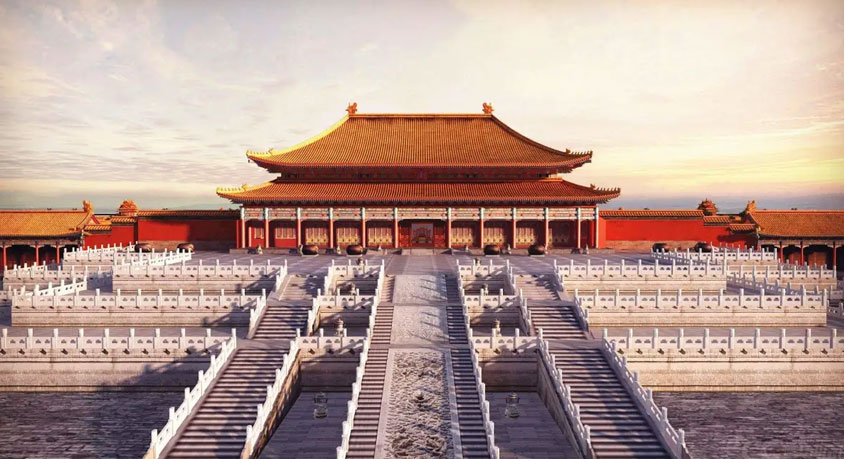
The Forbidden City is divided into two parts, the “outer court” and the “inner court”, in the north and south. The southern half of the Palace is centered on the three great halls of Taihe, Zhonghe and Baohe. Entered from the Noon Gate, the first to see the main door of the outer dynastic “Taihe Gate”, followed by the “Hall of Supreme Harmony”, commonly known as the “Hall of the Golden Emperor”, decorated with luxury, is the Ming and Qing emperors held a large ceremony of the dynasty place, is also the largest and highest grade of the Palace. “Hall of harmony” plane for the square, is the emperor held before the ceremony rest place. “Baohe Temple” inside and outside the gold dragon color painting, rich and noble, both sides of the Palace of Wuying Hall and the Hall of Wenhua and the three halls together to form a ‘former dynasty’, is the place of the emperor's pilgrimage.
---
The northern half to dry Qingmen, Jiaotai Hall, Kuning Palace and the Imperial Garden as the center. The east side of the Palace of Fengxian and the Imperial Palace, the west side of the Yuhua Pavilion, Cining Palace and the Palace of Yangxin, etc., is the emperor and consort to live, deal with political affairs and hold ceremonies “after the bedchamber” of the place. “dry Qing door” is the main door of the inner court, on both sides of the glazed shadow wall, is the emperor of the Qing dynasty royal door to listen to political ceremonies and other rituals place. “Jiao Tai Hall” is located in the dry Qing Palace and Kuning Palace, is huanghou by the celebration of the place. “Kunning Palace” in the Ming Dynasty is the Empress's bedchamber, the Qing Dynasty was changed to the shaman sacrifice to teach the shrine and the Emperor's bridal chamber. “Imperial Garden” in the back of the Kun Ning Palace, the building is symmetrical and not dull, the garden is full of greenery, colorful stone pavement, is the largest garden in the Palace, for concubines to rest.